The International Space Station (ISS) is one of humanity’s most remarkable engineering and scientific achievements—a large research laboratory orbiting Earth in low Earth orbit. It is not simply a spacecraft; it is a permanently operating microgravity laboratory, technology testbed, Earth-observation platform and international research facility.
The ISS brings together the space agencies of the United States, Russia, Europe, Japan and Canada, with astronauts, engineers, scientists and mission-control teams from different countries working together to operate and maintain the station. The first major elements were launched in 1998, and the station has been continuously occupied since 2000.
What Is the ISS?
The ISS is a huge modular structure assembled in space over many years. It contains living quarters, laboratories, solar power systems, communication equipment, robotic systems, docking ports and other facilities required to support astronauts.
The station travels around Earth at roughly 28,000 km/h and completes an orbit approximately every 90 minutes, meaning astronauts experience around 16 sunrises and sunsets every day.What Is the ISS?
The ISS is a huge modular structure assembled in space over many years. It contains living quarters, laboratories, solar power systems, communication equipment, robotic systems, docking ports and other facilities required to support astronauts.
The station travels around Earth at roughly 28,000 km/h and completes an orbit approximately every 90 minutes, meaning astronauts experience around 16 sunrises and sunsets every day.
Who Is Involved?
The ISS is an international partnership involving five major space agencies:
| NASA | United States |
| Roscosmos | Russia |
| ESA | European Space Agency |
| JAXA | Japan Aerospace Exploration Agency |
| CSA | Canadian Space Agency |
Each partner contributes spacecraft, equipment, laboratories, technology, crew, operational support and expertise. The ISS is designed so that its different sections and systems work together; no single partner independently provides everything required to operate the entire station.
What Does the ISS Do?
The primary purpose of the ISS is research. Space provides an environment that cannot easily be reproduced on Earth, particularly microgravity. Scientists use this environment to study how materials, fluids, biological systems and the human body behave when gravity is greatly reduced.
Research aboard the ISS covers areas including:
- Human Health: Astronauts spend long periods in space, allowing researchers to study how spaceflight affects the human body, muscles, bones, vision, sleep and other biological systems. This research is important for future long-duration missions to the Moon and Mars.
- Physical Science: Microgravity allows scientists to investigate physical processes that behave differently on Earth. Experiments can examine fluids, combustion, materials, crystals and other physical phenomena.
- Earth Observation: The ISS provides a unique viewpoint for observing Earth. Cameras and scientific instruments can be used to study Earth's atmosphere, weather, environmental changes and natural phenomena.
- Technology Testing: New technologies and systems can be tested in the harsh environment of space before they are used on future missions. The ISS therefore acts as an important testbed for technologies needed for future human exploration.
- Living and Working in Space: Another major role of the ISS is learning how humans can live and work in space for long periods. Astronauts perform scientific experiments, maintain equipment, conduct spacewalks and support visiting spacecraft. Continuous human presence provides valuable experience for future deep-space missions.
How Does the ISS Stay Operational?
Keeping the ISS functioning is a massive international engineering effort. Its systems include solar power generation, life-support systems, computers, communications, propulsion, navigation, thermal control and attitude control.
For example, solar panels generate electrical power, while life-support systems help maintain a breathable atmosphere. The station also requires regular maintenance and occasional orbital adjustments. Russia provides major propulsion capabilities, while U.S. gyroscopes provide everyday control of the station's orientation. Communications systems allow information and data to be exchanged between the station and mission-control facilities on Earth.
Astronauts Are Not the Only People Behind the ISS
Although astronauts are the people we see aboard the station, thousands of people on Earth contribute to its operation. Engineers, scientists, flight controllers, mission planners, software specialists, medical teams, technicians and researchers work together to keep missions running safely.
The ISS therefore represents much more than a structure floating above Earth—it is a demonstration of what can be achieved when countries, scientists and engineers combine their knowledge and resources.
How Can You Track the ISS?
If you are interested in watching the ISS from Earth, the ISS Live Now Android app provides a real-time ISS tracker, orbit map, visible-pass alerts and other space-related features.
You can use it to check where the ISS is, when it will pass over your location and when a visible pass is expected.
ISS Visible Over Kerala
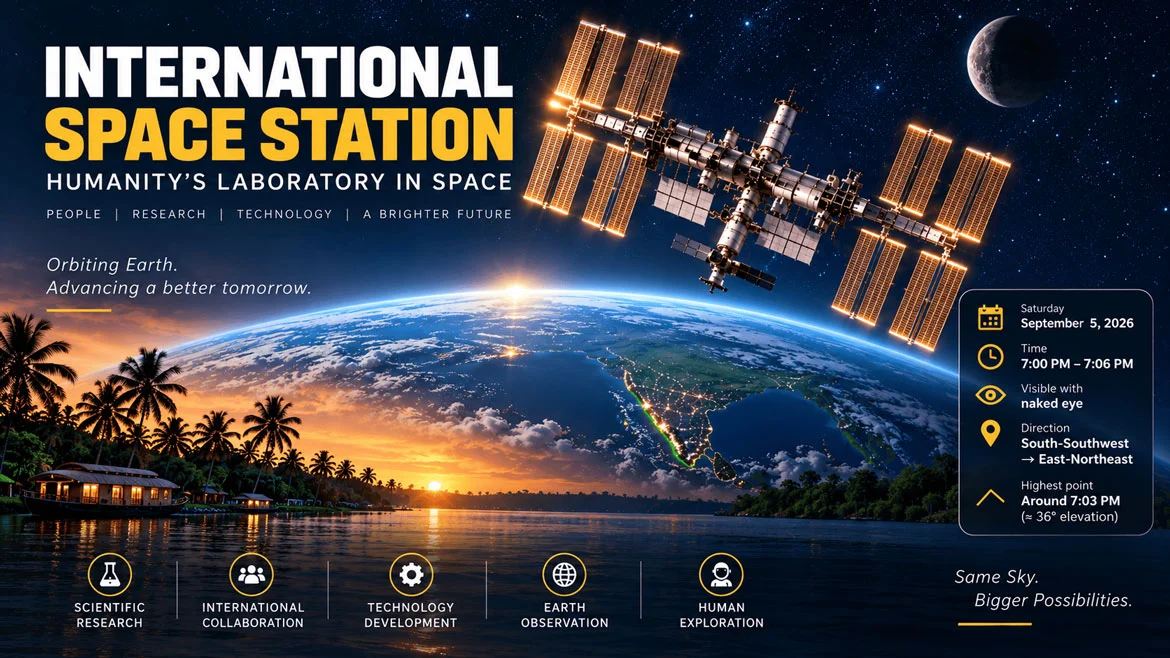
For Kerala, the ISS can occasionally become visible as a bright point of light moving rapidly across the evening sky. For the September 5, 2026 pass, the expected viewing window is around 7:00 PM to 7:06 PM, making it possible to observe the station with the naked eye if the sky is clear. Exact visibility depends on your location and local conditions, so checking an ISS-tracking app shortly before the pass is recommended.